Gang Wars : Street Crime
- 4.6
- Rating
- 500.00K
- Installs
- Free
- Price

 Analysis by App-foxy
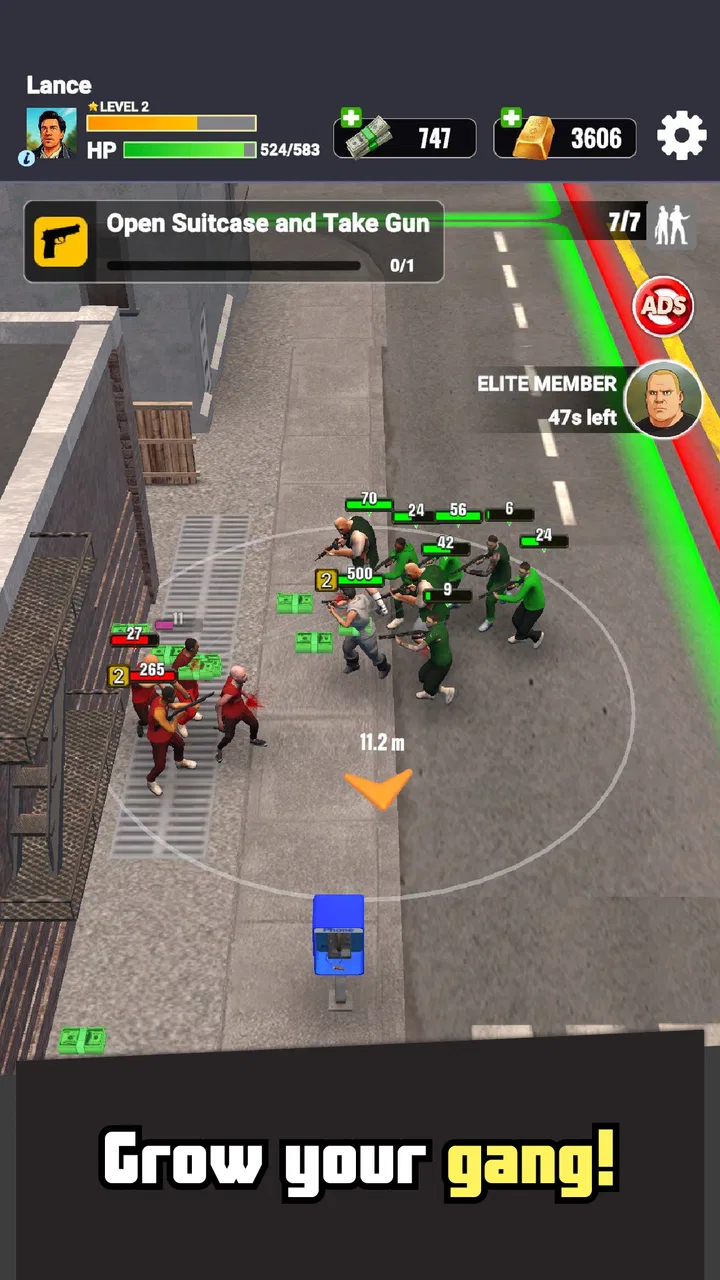
Gang Wars: Street Crime presents itself as a mobile action game built around territory, squads, and quick decisions. I went in expecting a straightforward street-battle experience, but what stayed with me was how closely its visual identity and match rhythm support that central idea. The game wants every move to feel like a contest for control rather than a simple race toward a high score, and that gives its compact battles a clear purpose.
It is free to play, which makes it easy to try without committing money first. The game is listed for a Teen audience, and its current version is 0.6.07. It comes from Skyloft Yazılım Bilişim ve Anonim Şirketi, a developer whose name is worth noting if you like following smaller or less familiar studios instead of only playing the biggest mobile releases.
My overall impression is positive, but not uncritical. Gang Wars: Street Crime works best when you treat it as a focused action game about pressure and positioning, not as a deep crime simulation or a full replacement for a large-scale console shooter. Its strongest quality is the way its setting gives meaning to the basic loop: assemble a squad, push into contested space, and decide when holding ground matters more than chasing another elimination.
You May Also Like

 Blood Strike: 2.5 Anniversary
Blood Strike’s Loadouts Turn Every Drop Into a Tactical Gamble
A close look at Blood Strike’s custom loadouts: how fast access to signature weapons reshapes its battle royale rhythm, rewards preparation, and narrows the gap between fights.

 Pandora - Music & Podcasts
Pandora’s Music Is Easy to Start, but Harder to Recover
Pandora’s strength is its low-effort path from a seed to a station. Its weak spot is how much confidence it asks you to place in connection, setup, and quiet recovery.

 8 Ball Pool
 Is Built on Rivalries, Rematches, and Routine
A close look at the rivalries, rematches, shared routines, and unanswered safety questions that turn a quick pool match into a persistent mobile community.

 Samsung Music
’s Quiet Strength Is Playing What You Already Own
Its reach comes less from spectacle than from dependable access to a personal library. That simplicity is both the app’s strongest retention engine and its ceiling.

 AccuWeather: Weather Radar
AccuWeather Review: A Quick, Clear Forecast for Everyday Decisions
For everyday plans, the best forecast is the one you can understand quickly. AccuWeather makes rain timing, radar, and local conditions easy to act on, with a few trade-offs.

 Hill Climb Racing
Why Hill Climb Racing Still Turns Crashes Into One More Run
A tiny car, a bumpy hill and one more upgrade: Hill Climb Racing keeps resurfacing because its simple chaos makes every near-miss feel personal.
More From Our News Desk
View All News


First impressions: a compact battle built around control
The opening appeal is easy to understand. You are not simply moving through a level and clearing targets one by one. The central promise is about building a group and taking zones, so the battlefield immediately feels more strategic than a purely reaction-based arena. Even when the action becomes hectic, I found myself thinking about routes, timing, and whether a temporary advantage was worth the risk of overextending.
That distinction matters on a phone. Many action games rely on constant visual noise, rapid rewards, and short encounters that blur together. Here, the idea of territory gives each confrontation a readable objective. A zone is not just another point on a map; it is a reason to move, defend, regroup, or force an opponent away from a useful position. This makes the action easier to follow than a match where every player is simply hunting for the next target.
The game has attracted a 4.3 average from around 7.3 thousand ratings, with more than 500 thousand installs. Those figures suggest that it has found an audience beyond a tiny early group, though I would still approach it as a developing mobile title rather than a completely mature competitive platform. That is especially relevant for players who care about long-term balance, a large variety of modes, or highly polished matchmaking.
One practical question is whether it suits short play sessions. In my experience, its zone-focused structure makes it a reasonable fit for a spare moment because you can enter with a clear objective instead of needing a long story sequence. At the same time, the pressure of defending territory can make a session feel more involved than a casual tap-through game. If you only want something passive while waiting for a bus, this may demand more attention than expected.
The first useful habit I developed was to avoid treating every encounter as a demand to attack immediately. A squad can create pressure simply by threatening a route or forcing an opponent to watch a captured area. That changes the value of movement: sometimes the best play is not the most aggressive one, but the one that makes the other side react first.
Who will understand the appeal quickly?
I would recommend it first to players who enjoy action games with a visible objective and a modest layer of tactical decision-making. If you like the feeling of turning a chaotic fight into a contest over meaningful spaces, the design has a clear hook. It is also a good match for people who prefer a gritty urban mood over bright fantasy worlds or military realism.
Players who want a large campaign, detailed character stories, or a slow role-playing progression should be more cautious. The game’s identity is tied to the battlefield loop, so it does not appear designed to replace a narrative adventure. Likewise, if you dislike games where a match can swing because of one poorly timed push, the territory structure may feel stressful rather than satisfying.
There is also a difference between enjoying the theme and enjoying the controls. A street-crime setting can make a simple objective feel urgent, but it cannot remove the limitations of playing action games on a touchscreen. I found that the best experience came from giving the game my full attention and using deliberate movements instead of trying to play while distracted.
The world speaks through streets, colour, and pressure
The setting does useful work without needing to become a separate story. Gang Wars: Street Crime leans into the language of urban conflict: squads matter because safety comes from numbers, zones matter because space represents influence, and every advance carries the possibility of losing ground behind you. That is a more coherent foundation than simply placing generic combat inside a city backdrop.
What I appreciate is that the art direction supports the premise rather than competing with it. The game’s street identity gives the battlefield a sense of place, even when the core mechanics remain simple. Visual choices in this kind of game need to answer practical questions quickly: where is the contested area, where can pressure come from, and which side currently controls the important space? A style that is too decorative can make those answers harder to read.
The mood is not built only from dark imagery. It comes from the relationship between the environment and the objective. A captured zone feels like a temporary claim, not a permanent victory. That keeps the setting active in the player’s mind. You are not merely walking through a backdrop; you are trying to impose order on a place where control can change quickly.
One of the more interesting trade-offs is that a strong theme can narrow the audience. I found the urban gang-war tone more memorable than a neutral arena, but it will not appeal to everyone. Players looking for a cheerful, colourful, or family-oriented action game should choose something else. The Teen content rating also makes the intended mood clear: this is aimed at older players, not young children looking for a light cartoon brawler.
The setting also affects how I read the squad system. A group is not just a collection of units or avatars in the abstract. It represents influence and backup, which makes losing a position feel like a breakdown in control rather than a minor tactical inconvenience. That interpretation is valuable because it gives emotional weight to otherwise familiar actions such as advancing, defending, and regrouping.
Art direction versus readability
For a territory game, visual clarity has to win every argument. Style is welcome, but I need to understand the battlefield at a glance. Gang Wars: Street Crime benefits when its urban presentation keeps the active objective obvious. When the screen becomes busy, the most important question is not which decoration looks impressive; it is whether I can instantly tell where my squad should be and what I am risking by moving away.
That leads to a practical tip: do not judge a position only by how close it is to the next zone. Consider the route back as well. A forward location may look attractive because it applies pressure, but if it leaves your current area exposed, the visual excitement of the push can hide a poor exchange. The game’s atmosphere encourages boldness, while its objective structure rewards players who keep track of the whole field.
I also think the art direction works better for players who enjoy a defined mood than for players who need constant visual novelty. The appeal comes from consistency: the streets, the conflict, and the contest for influence all point in the same direction. It is less about showing off a new spectacle every minute and more about making the same world feel believable during repeated battles.
Sound and rhythm turn territory into tension
Sound is especially important in an action game with a street setting because it helps transform movement into momentum. A good audio layer should make a push feel different from a retreat and a contested zone feel different from empty space. In my play sessions, the overall mood worked best when the sound reinforced the idea that control was unstable and that the next few seconds could change the shape of the match.
The pacing follows the same principle. The game does not need every moment to be explosive. A short pause before a confrontation can be useful because it gives me time to decide whether to commit the squad or wait for a better opening. When the battle accelerates, that earlier decision makes the action feel earned rather than random.
This rhythm also creates one of the game’s main challenges for new players. A first-time player may see a quiet moment and assume nothing important is happening, then discover that an opponent has used the same pause to take a better route. I learned to treat inactivity as information. If nobody is visibly attacking, someone may still be preparing a position, testing a response, or waiting for me to leave a zone unguarded.
That is where the audio-visual mood and the mechanics fit together nicely. The street atmosphere suggests danger even before a fight begins, while the zone objective gives that danger a concrete location. Instead of wandering through an empty city, I am listening and watching for the point where pressure will become a direct contest.
A realistic everyday scenario shows the game’s strengths and weaknesses. Imagine opening it during a short break after work. You have enough time for a focused match, but not enough patience for a long campaign chapter or an elaborate setup. The clear objective lets you get into the action quickly, and the urban mood makes the session feel distinct from a generic arcade round. However, if your break is interrupted often, the need to pay attention to territory can become frustrating. This is a game for active short sessions, not something I would leave running in the background.
How I manage the pace
My most useful approach is to divide a match into three mental phases: establish, pressure, and secure. First, I look at how the squad can reach useful space without creating an unnecessary opening. Then I apply pressure where it can force a response rather than simply moving toward the nearest visible target. Finally, I decide whether the current advantage is worth defending or whether the squad should reposition.
This is not a formal mode or a hidden menu feature; it is a way of reading the game. It prevents the common mistake of confusing movement with progress. In a territory battle, travelling farther does not automatically mean winning. A slower action that preserves control can be more valuable than a dramatic push that leaves the squad scattered.
The sound and pacing also make the game more suitable for players who enjoy tension than for those seeking relaxation. I often felt that a seemingly small decision carried consequences because the objective was spatial. If that pressure is exactly what you want from an action game, it gives the matches character. If you prefer predictable enemies and a calm power fantasy, the same design may feel demanding.
Where the mechanics fit, and where they ask for patience
The mechanical core is easy to describe but harder to use well: build a squad, capture zones, and dominate the battlefield. The interesting part is how those pieces depend on one another. A squad without a plan can lose ground quickly, while a captured zone without enough attention can become a temporary achievement. The game encourages me to think in terms of relationships rather than isolated actions.
Squad building is most useful when it supports a clear purpose. I do not want to assemble a group simply because a particular member looks powerful. I want to know what the group is meant to do: hold a position, create pressure, or help recover after a failed push. Even without turning the experience into a complicated strategy simulator, this mindset makes the choices feel more deliberate.
Zone capture gives the match its shape. It creates a reason to leave safety, and it also creates a reason to stop moving. That second point is easy to overlook. Many action games reward constant forward motion, but this one makes staying in the right place a meaningful skill. I found that the strongest moments came when I resisted the urge to chase and instead protected the advantage already earned.
The trade-off is that the game may feel less satisfying if you want every action to produce an immediate reward. Capturing space can require patience, and defending it may seem less exciting than attacking. The payoff arrives through control over the battlefield, not necessarily through a flashy individual moment. Players who enjoy objective play will understand this quickly; players who mainly want personal elimination streaks may feel restricted.
There is also a monetization consideration. The game is free to download, and its in-app purchases range from $1.99 to $49.99 per item. That does not by itself tell me how every purchase affects play, but it is enough reason to approach spending carefully. I would play without buying anything first, learn how the squad and zone loop feels, and only then decide whether optional purchases genuinely improve my enjoyment rather than simply speeding up impatience.
This is especially important for anyone sharing a device or account with a younger player. The Teen rating already suggests that the tone is not intended for children, and the presence of purchases means I would set expectations before handing over the phone. The game is free to start, but “free” should not be mistaken for a completely cost-free experience if the player becomes invested in progression or customization.
Three practical lessons that improve the experience
First, I recommend choosing a squad with the next objective in mind instead of building around a single favourite. A group that looks strong in an isolated clash may be awkward when it has to capture and then hold space. The best choice depends on the job the battlefield is asking for at that moment.
Second, use the edge of a contested area as a decision point. Moving directly into the centre can feel decisive, but approaching from a safer angle may preserve more options. If the push fails, a squad with a retreat route can recover; a squad that has committed too deeply may turn one lost contest into a larger collapse.
Third, judge success by the state of the map, not just by the most dramatic exchange. A quiet defence that keeps an important zone secure can be a better result than a successful attack that leaves the rest of the field open. This is the kind of insight that the short store summary cannot communicate, but it changes how I play.
Compared with a traditional single-player action game, Gang Wars: Street Crime offers less control over the pace and less emphasis on a personal hero’s journey. Compared with a pure arena shooter, it gives movement a stronger strategic purpose because locations matter. And compared with a deep strategy game, it is more immediate and action-led, asking for quick judgement rather than long planning sessions.
That middle position is its real appeal. I can approach it casually, but the territory system gives me room to improve. I do not need to memorise a huge rulebook to begin, yet I can still refine how I time a push, protect a route, or select a squad for a specific battlefield problem. The game is at its best when those layers remain connected instead of becoming separate systems.
Questions I would answer before installing
If you are wondering whether it can be played without spending, my answer is yes as a starting point: the game is free, and I would absolutely try the core loop before considering purchases. The sensible approach is to decide whether the action and territory battles are enjoyable on their own. If they are not, buying something will not fix the underlying mismatch.
If you are asking whether it is suitable for children, I would not choose it for young players. Its Teen content rating and crime-focused setting point toward an older audience. It is better suited to someone comfortable with a darker urban action mood and with the responsibility that comes with optional in-app spending.
If you want to know whether it is more tactical than a typical mobile action game, I would say it has a meaningful tactical layer, but it remains an action title first. You still need to react quickly, and the game does not become a slow planning board. Its strategy comes from deciding where pressure belongs and when to protect an advantage.
If you are comparing it with a large, established competitive game, expectations matter. Gang Wars: Street Crime is attractive because its focus is narrower and its theme is more specific. A bigger alternative may offer broader content, more refined competitive infrastructure, or a deeper roster. This game is the better choice when you want a direct street-conflict atmosphere and a manageable objective loop rather than the biggest possible ecosystem.
Atmosphere verdict: a focused street-action experience
Gang Wars: Street Crime succeeds because its art direction, sound, setting, and pacing all point toward the same feeling: control is temporary, and every zone has to be earned and protected. The mechanics are not buried under the mood. Instead, the urban presentation gives the squad and territory systems a reason to matter.
I especially liked the way the game rewards restraint. It is tempting to play every moment as an attack, but the better decision can be to hold, observe, and make the opponent move first. That creates a more thoughtful rhythm than the title might suggest at first glance. The strongest player is not always the one making the loudest move; sometimes it is the one who understands which space must not be abandoned.
There are clear reasons to skip it. I would look elsewhere if I wanted a story-heavy crime game, a relaxed casual experience, or a completely frictionless action title with no concern about optional spending. I would also be cautious if touchscreen pressure and contested objectives tend to make mobile games feel tiring rather than exciting.
For the right player, though, the combination is convincing. The game is free, has a 4.3 average, and has already reached an audience of over 500 thousand installs, while its Teen rating accurately reflects its intended tone. I would recommend trying it to anyone who enjoys mobile action with a territorial backbone and a gritty sense of place.
My final view is that Gang Wars: Street Crime is most enjoyable when played as a battle of decisions rather than a collection of quick fights. It may not replace a larger competitive game or a full crime-world adventure, but it has its own clear identity. If you like building a squad, reading the battlefield, and turning urban tension into a contest for space, this is a worthwhile free game to test for yourself.
FAQs for Gang Wars : Street Crime
01What is the main objective of Gang Wars: Street Crime?
Gang Wars: Street Crime is an action-packed game where players immerse themselves in the gritty underworld of street gangs. The main objective is to build your gang, establish dominance over rival gangs, complete missions, and rise to the top of the criminal hierarchy. Players strategize to expand their territory and influence.
02Is Gang Wars: Street Crime free to play?
Yes, Gang Wars: Street Crime is free to download and play. However, it offers in-app purchases for various items and upgrades that can enhance gameplay. These purchases are optional, and players can still enjoy the game fully without spending money, although progress may be slower.
03What types of missions are available in the game?
The game offers a diverse range of missions, including territory takeovers, heists, and street battles. Each mission requires strategic planning and execution, with varying levels of difficulty. Completing missions rewards players with resources and reputation, which are crucial for gang growth and advancement.
04How do in-app purchases affect gameplay?
In-app purchases can significantly impact gameplay by providing players with access to exclusive items, faster upgrades, and additional resources. While they are not necessary to enjoy or succeed in the game, they offer a more enhanced and streamlined experience for those who choose to invest financially.
05Is an internet connection required to play Gang Wars: Street Crime?
Yes, an internet connection is required to play Gang Wars: Street Crime. This ensures that players can interact with online features such as multiplayer battles, leaderboards, and in-game events. A stable connection enhances the overall gaming experience and enables real-time updates and interactions.
Pros
- Immersive open-world environment.
- Varied missions and challenges.
- Intuitive controls and gameplay.
- Regular updates and events.
- Engaging storyline and characters.
Cons
- In-app purchases can be costly.
- Occasional bugs and glitches.
- Requires constant internet connection.
- High battery consumption.
- Large storage space needed.

Gang Wars : Street Crime
Gallery